Transformers and Transformer Winding · Volume 3
A Short History: From Faraday's Ring to the Grid
3.1 Why a lump of iron and wire deserves a history
Of all the components in the passive-components program, the transformer is the one that changed the shape of the world. A capacitor stores a little charge; a resistor drops a little voltage; a coil resists a change in current. Useful, all of them, but domestic in scale. The transformer is different. It is the device that made it possible to generate electricity in one place and use it a hundred miles away, and in doing so it decided the single most consequential engineering argument of the nineteenth century — whether the modern world would run on direct current or alternating current. The answer, alternating current, was really an answer about the transformer, because the transformer is the one machine that makes voltage cheap to change, and cheap voltage transformation is the whole reason an alternating-current grid is possible at all.
That is a large claim to hang on a lump of laminated iron with two coils of wire wound round it. This volume earns it, by following the transformer from the afternoon in 1831 when Michael Faraday first saw a galvanometer needle twitch, through the induction coils of Victorian physics, the false start of the open magnetic circuit, the Hungarian breakthrough that gave the device its name, the American demonstration that put it on the street, the propaganda war that nearly killed alternating current anyway, and the polyphase system that finished the argument at Niagara Falls. It ends where every reader of this dive already lives: in a world where a transformer sits inside every power supply, hangs from every second utility pole, and squats in every substation, so ubiquitous that it has become invisible.
The companion history volume in the coils dive told part of this story from the inductor’s side, and it need not be repeated here. What follows is the transformer’s own account. It is a story with an unusual number of near-simultaneous discoveries, disputed priorities, and half-forgotten inventors, and the honest version keeps all of them in view.
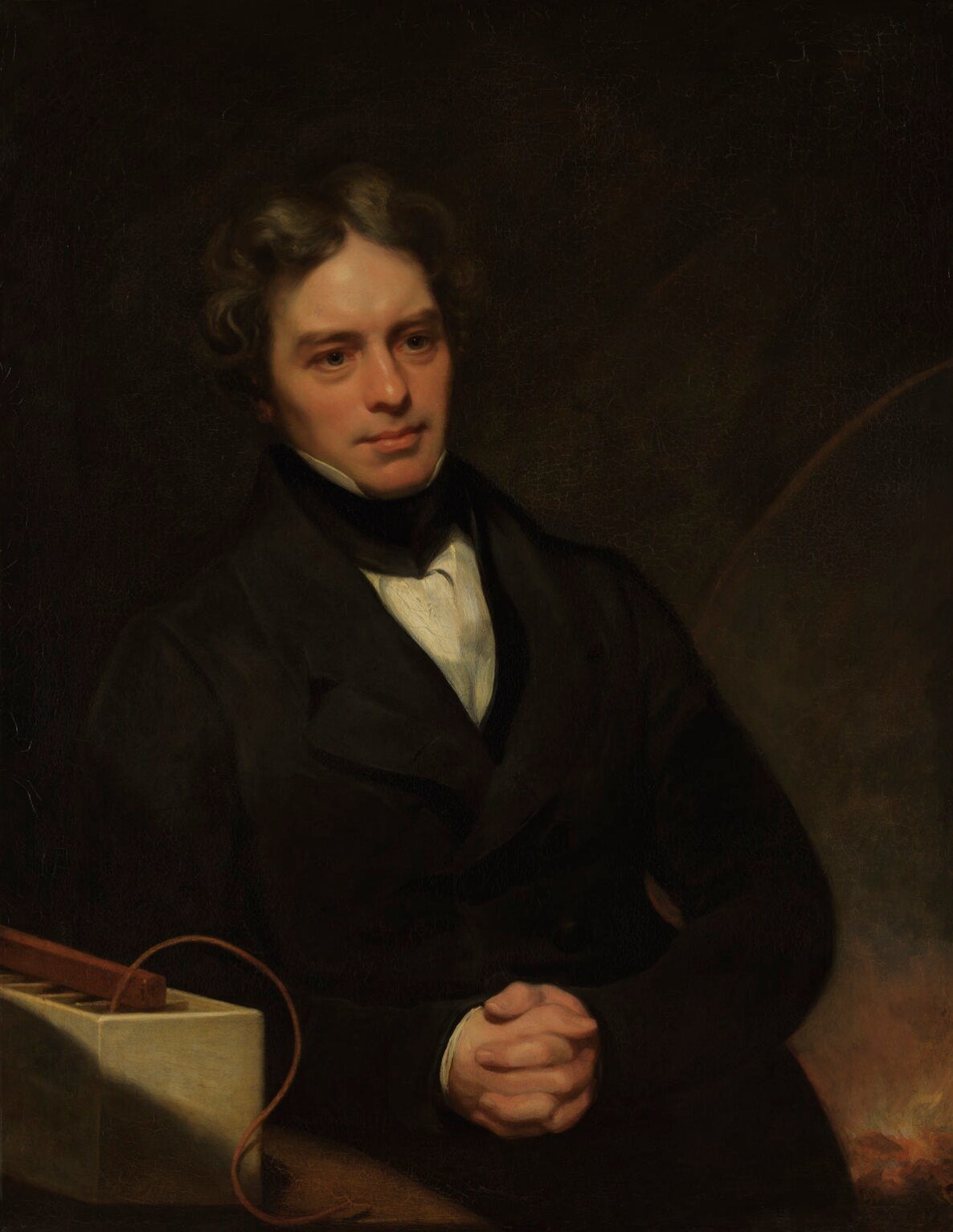
3.2 Faraday’s ring, 1831: the founding experiment
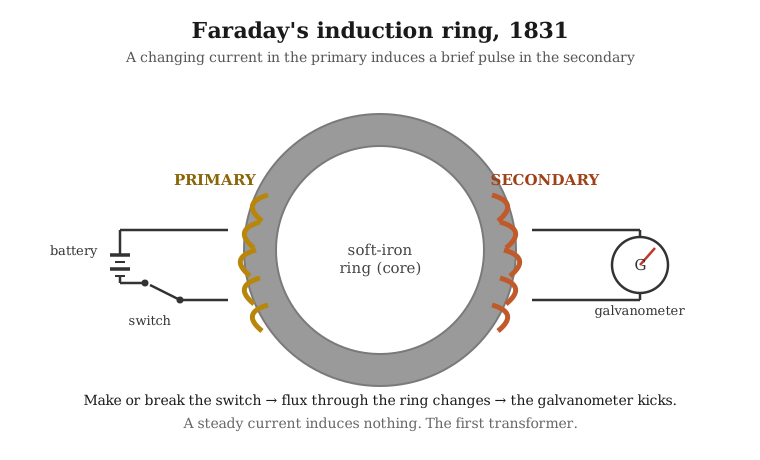
The transformer begins with a wedding ring of iron about six inches across. On the 29th of August 1831, at the Royal Institution in London, Michael Faraday took such a ring of soft iron and wound two entirely separate coils of copper wire onto it, on opposite sides. One coil — call it the primary, though Faraday did not — he could connect through a switch to a battery of voltaic cells. The other coil, the secondary, he connected to a galvanometer, a sensitive current detector consisting of a magnetic needle inside a small coil. The two windings shared nothing but the iron ring; no wire ran from one circuit to the other. By the electrical common sense of the day, closing the battery circuit ought to have done nothing whatever to the galvanometer across the room.
It did something. At the instant Faraday closed the switch, the galvanometer needle kicked to one side, hesitated, and fell back to rest even though the battery was still connected and current was still flowing steadily in the primary. When he opened the switch, the needle kicked the other way and again settled. A steady current produced no lasting effect at all; only the act of making or breaking it — the moment of change — reached across the iron and stirred the second circuit.
Faraday understood at once what he had found, and it is worth stating in the plain terms he arrived at, because the whole of transformer theory unfolds from it. The current in the primary magnetised the iron ring. A steady current made a steady magnetism, and steady magnetism, sitting there, induced nothing. But a changing current made a changing magnetism, and a changing magnetic flux threading the secondary winding drove a voltage around it. The induced voltage was proportional not to the flux but to the rate of change of the flux — the faster the magnetism rose or collapsed, the harder the secondary was pushed. This is Faraday’s law of induction, and in its two-winding form on a shared iron core it is, quite literally, the equation of the transformer. The theory volume of this dive states it precisely; here it is enough to recognise that the ring on Faraday’s bench was the first transformer that ever existed, some fifty years before anyone built one to do useful work.
Faraday was not primarily chasing the transformer, of course. He was after the grand symmetry of nature: Hans Christian Ørsted had shown in 1820 that an electric current makes a magnetic field, and Faraday was hunting the converse, that magnetism could make electricity. The ring gave him one form of the answer. Within weeks he had the other and more general form — that simply moving a magnet in and out of a coil generates a voltage with no second circuit at all — and from that came the disc dynamo, the ancestor of every generator. But the ring is the ancestor we care about, because it induces electricity from electricity, using magnetism only as the go-between, and that is exactly what a transformer does.
3.2.1 Joseph Henry, working in parallel
The story of induction is, like so much of early electricity, a story of two men arriving at nearly the same place at nearly the same time. While Faraday worked in London, an American schoolteacher named Joseph Henry was performing closely related experiments in Albany, New York. Henry had built the most powerful electromagnets in the world by insulating his wire — wrapping it in silk so that many close turns could be wound without shorting — and in the course of that work he had noticed the vicious spark that leapt across the contacts whenever he broke the circuit of one of his big magnets. That spark was self-induction: the coil, its own magnetism suddenly collapsing, inducing a large voltage in itself and trying to keep its current flowing across the opening gap. Henry understood this effect and is rightly credited as the first to describe self-inductance, the property that later gave the coil its unit, the henry.
Henry very probably observed mutual induction between two coils at least as early as Faraday, but the schoolteacher’s timetable left him little opportunity to write up and publish, and Faraday’s paper reached print first. The point for this volume is not to adjudicate a priority dispute nearly two centuries old, but to note that the founding idea of the transformer was, from the very beginning, robust enough to be discovered independently on two continents. It was not a fluke of one laboratory. It was in the nature of things, waiting to be seen by anyone who wound two coils on a common core and had the wit to watch for the flick of a needle at the moment of change.
3.3 The induction coil: chopping direct current into high voltage
For half a century after Faraday, the transformer-as-power-device did not exist, for the simple reason that there was almost no alternating current to feed it. The electricity of the age came from batteries, and batteries deliver steady direct current, which a transformer cannot use. Faraday’s law demands change, and a battery, left to itself, provides none.
But there was a way to cheat. If a battery will not vary its current, a mechanism can vary it for you — chopping the direct current on and off many times a second, so that each interruption produces the collapsing flux that induction requires. Marry that chopper to Faraday’s two-winding ring, give the secondary far more turns than the primary, and each interruption throws a high-voltage pulse across the secondary. This is the induction coil, and it was the first descendant of Faraday’s ring to become a manufactured product rather than a laboratory curiosity.
The device was invented in 1836 by the Reverend Nicholas Callan, professor of natural philosophy at Saint Patrick’s College in Maynooth, Ireland. Callan wound a primary of a few turns of thick wire and a secondary of many thousands of turns of fine wire on a common iron core, and he chopped the primary’s battery current with a mechanical interrupter — in his first version, an assistant who repeatedly broke the connection by hand, and soon a rotating toothed wheel that did the job automatically. Because the secondary carried so many more turns than the primary, the voltage induced in it at each interruption was enormous, enough to leap a spark gap several inches long. Callan had built the first practical step-up transformer, driven not by alternating current, which barely existed, but by a violently chopped direct current.
The induction coil is usually named not for Callan but for the Parisian instrument-maker Heinrich Daniel Ruhmkorff, who from 1851 built and sold beautifully made coils that drew sparks a foot or more in length and became standard equipment in every serious physics laboratory in Europe and America. It is a little unfair to the Irish priest, but the phrase “Ruhmkorff coil” has stuck, and it is worth pausing over the machine because two of its refinements matter to the whole subsequent history.
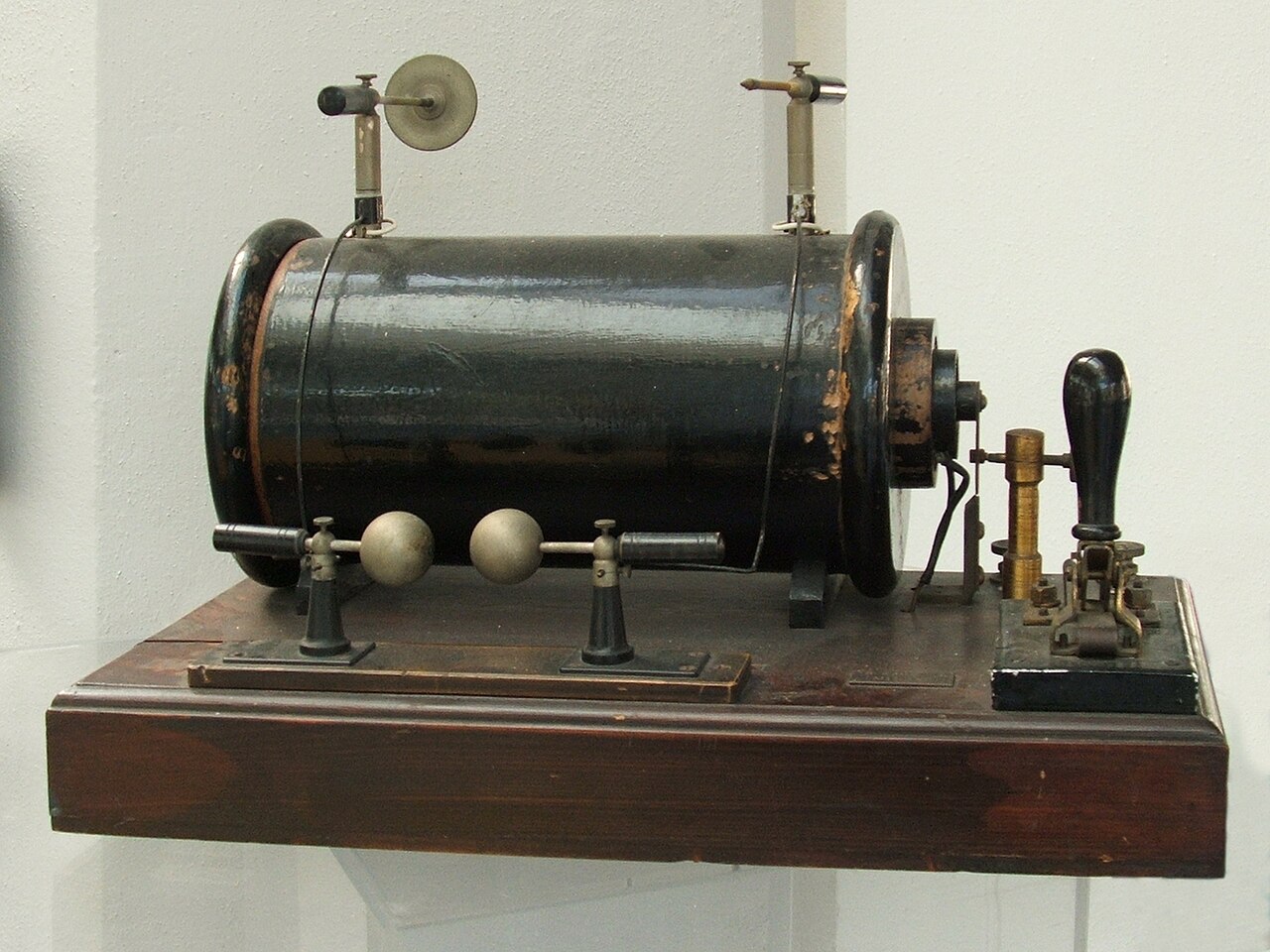
The first refinement was the interrupter itself, a spring-and-hammer contact that made and broke the primary automatically, tens or hundreds of times each second — the same self-interrupting trick that rings an electric bell. The second, added by Armand Fizeau in 1853, was a capacitor placed across the interrupter contacts. Without it, the collapsing primary threw a fat spark across the opening contacts, which held the current up, slowed the collapse, and blunted the very change the coil depended on. The capacitor absorbed that surge, let the contacts part cleanly, and sharpened the collapse, squeezing far more voltage out of the secondary. A reader of the capacitors dive will recognise this as the direct ancestor of the contact-breaker condenser in a car’s ignition system — and indeed the automobile ignition coil is a Ruhmkorff coil in all but name, still chopping the low-voltage direct current of a battery into the tens of thousands of volts a spark plug needs.
The induction coil’s reach in the second half of the nineteenth century is hard to overstate. It excited the glowing Geissler and Crookes tubes of physics lectures; it drove the first X-ray tubes, so that when Wilhelm Röntgen discovered X-rays in 1895 the high voltage behind his apparatus came from a Ruhmkorff coil; and it powered the spark-gap transmitters of the first wireless telegraphy, so that the opening chapter of radio was written by a coil chopping direct current into sparks. But for all its importance, the induction coil was a step-up device fed by a chopped battery, producing spiky pulses, not the smooth sinusoidal alternating current of a power system. It was the conceptual bridge to the transformer — proof that a two-winding iron-cored coil could multiply voltage by the ratio of its turns — but it was not yet the thing itself. The thing itself had to wait for a supply that alternated on its own.
3.4 The open-core false start: Gaulard and Gibbs
That supply arrived in the 1870s and early 1880s, as alternating-current generators, or alternators, matured for arc lighting. Arc lamps ran happily on alternating current, and the alternator, having no commutator to spark and wear, was a simpler machine than a direct-current dynamo. For the first time there was a source that changed its own current continuously, sinusoidally, without any need for a mechanical chopper. Faraday’s law could now be satisfied by the supply itself. The transformer had its power source at last; what it lacked was a good transformer.
The first serious attempt at a distribution transformer came from a French inventor, Lucien Gaulard, working with an English financier and engineer, John Dixon Gibbs. From 1882 they built and demonstrated a device they called a “secondary generator,” which was a transformer in function if a poor one in design. Their apparatus had an open magnetic circuit: the iron core was a straight bundle of iron wires, or a set of straight bars, with the windings wrapped around it, and the magnetic flux had to complete its loop by struggling back through the surrounding air. They exhibited the secondary generator in London in 1883 and, most spectacularly, at the Turin International Exhibition in 1884, where a chain of their transformers, fed at a couple of thousand volts and 133 hertz, distributed power along some tens of kilometres of the Turin-to-Lanzo railway line to run lamps at intervals.
It looked, at Turin, like a triumph, and it drew the attention of George Westinghouse in America, who bought rights to the design. But the Gaulard-and-Gibbs system carried two flaws that would prove fatal, and understanding them is the best possible preparation for appreciating the breakthrough that followed.
The first flaw was the open core. Air is a poor conductor of magnetic flux — thousands of times poorer than iron — so an open magnetic circuit forces most of the flux to leak away through the air rather than link cleanly from primary to secondary. That leakage is wasted, it demands a large magnetising current to drive it, and it makes the transformer inefficient and its secondary voltage soggy and hard to predict. The second flaw was in how the transformers were connected. Gaulard and Gibbs wired the primaries of their several transformers in series, threading the same line current through all of them like beads on a string. A series system has a nasty property: the voltage that appears at any one transformer depends on what all the others are doing, so switching one lamp bank on or off shifted the voltage at every other point on the line. It was very difficult to keep the lamps at a steady, uniform brightness, which is the one thing a lighting customer actually wants.
These were not small engineering wrinkles to be polished out. They were the wrong architecture. The open core wasted flux, and the series connection made the whole system interact with itself. What was needed was a transformer with a closed iron path, so that essentially all the flux stayed in the iron and linked both windings, and a way of connecting many such transformers so that each delivered a constant voltage regardless of its neighbours. Both answers came, together, from Budapest.
3.5 The ZBD transformer, 1885: the breakthrough at Ganz
At the Ganz Works, a large electrical-engineering firm in Budapest, three young engineers took up the problem in 1884 and solved it so completely that their design is, in its essentials, the transformer still built today. Their names were Károly Zipernowsky, Ottó Bláthy, and Miksa Déri, and their initials have given the device its historical name: the ZBD transformer.
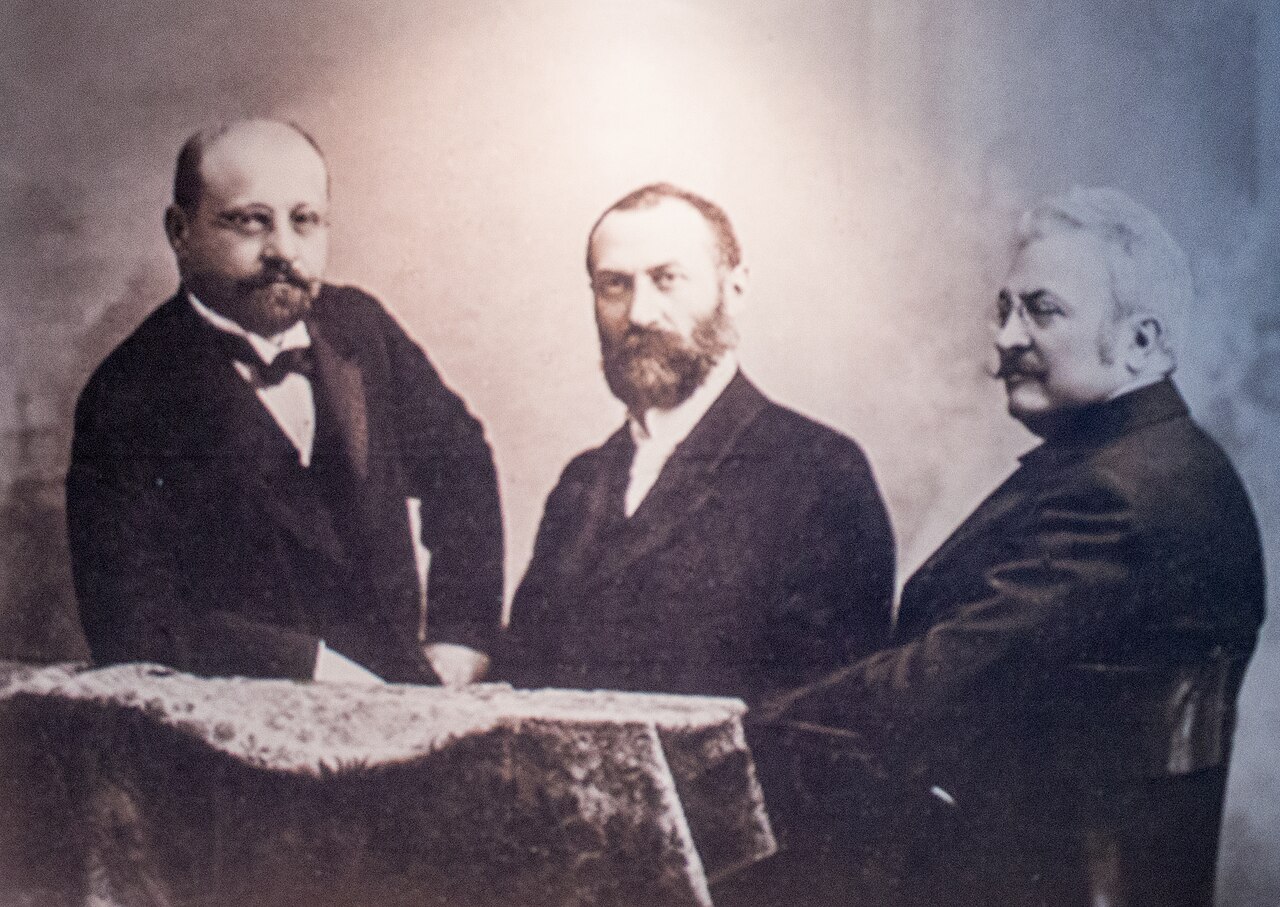
The ZBD team’s first great decision was to close the magnetic circuit. In the autumn of 1884 they had convinced themselves, by experiment, that the open-core secondary generator was a technical dead end — it could not regulate its voltage reliably — and they turned to designs in which the iron formed a complete, unbroken loop. In their joint patent applications of 1885 they described two closely related forms. In one, which they called the “ring” type, the windings were wound around a closed ring of iron wire — geometrically the direct descendant of Faraday’s ring. In the other, which they called the “shell” type, an iron core was built up around the windings, enclosing them. Both share the essential feature: the flux runs entirely within iron, from primary to secondary and back, with no air gap for it to leak across. Bláthy is generally credited with pressing for the closed core, and it made the transformer’s behaviour predictable and its efficiency high. To keep eddy-current losses down they built the core not from solid iron but from many thin iron wires or laminations, insulated from one another — a subject the core-materials volume of this dive takes up in full.
Their second great decision was in how to connect the transformers to the line, and it was every bit as important as the core. Instead of stringing the primaries in series as Gaulard and Gibbs had, the ZBD team connected them in parallel — in what they called a shunt arrangement — all hung across the same constant-voltage supply line, like the branches of household wiring today. Zipernowsky is particularly associated with this parallel-connection idea. Its consequence is exactly what a lighting utility wants: each transformer sees the full line voltage on its primary and therefore delivers its own steady, predetermined secondary voltage, entirely independent of how many lamps its neighbours have switched on or off. Turn a lamp on anywhere and it simply draws its share of current; the voltage everyone else sees does not budge. This is the constant-voltage, parallel-distribution principle, and every mains outlet in the world still works this way. Déri, the third of the trio, carried out much of the experimental work that turned these ideas into a working system.
There is one more debt the whole field owes to this team, and it is the humblest: the word. It was Ottó Bláthy who coined the term transformer for the new device, and the name has proved as durable as the design. Before Bláthy the thing had been called a secondary generator, an induction apparatus, a converter — a muddle of names for a muddle of imperfect machines. After Bláthy it had one clear name, and by no coincidence that clarity arrived with the first machine that truly deserved it.
The Ganz Works did not merely patent the idea; they shipped it. In the autumn of 1884 the factory delivered the world’s first batch of high-efficiency alternating-current transformers, and within a few years ZBD transformers were lighting cities. The closed core and the parallel connection between them made it, for the first time, technically and economically sensible to distribute electricity for lighting to homes, shops and streets. The transformer had stopped being a physics demonstration and become an item of infrastructure. What remained was to carry that infrastructure across the Atlantic and out onto the poles of an American town — which is where William Stanley comes in.
3.6 Stanley and Westinghouse, 1886: the light comes to Great Barrington
George Westinghouse had already made a fortune in railway air brakes and signalling when he turned his formidable industrial energy to electricity in the mid-1880s. He had bought the American rights to the Gaulard-and-Gibbs design, imported examples of the European transformers, and grasped the central strategic fact more clearly than almost anyone: that the future of electric power lay in high-voltage transmission stepped down for local use, and that the transformer was the key to it. What he needed was an engineer who could turn the promising but flawed European apparatus into a robust, manufacturable American system. He found him in a young, largely self-taught electrician named William Stanley Jr.
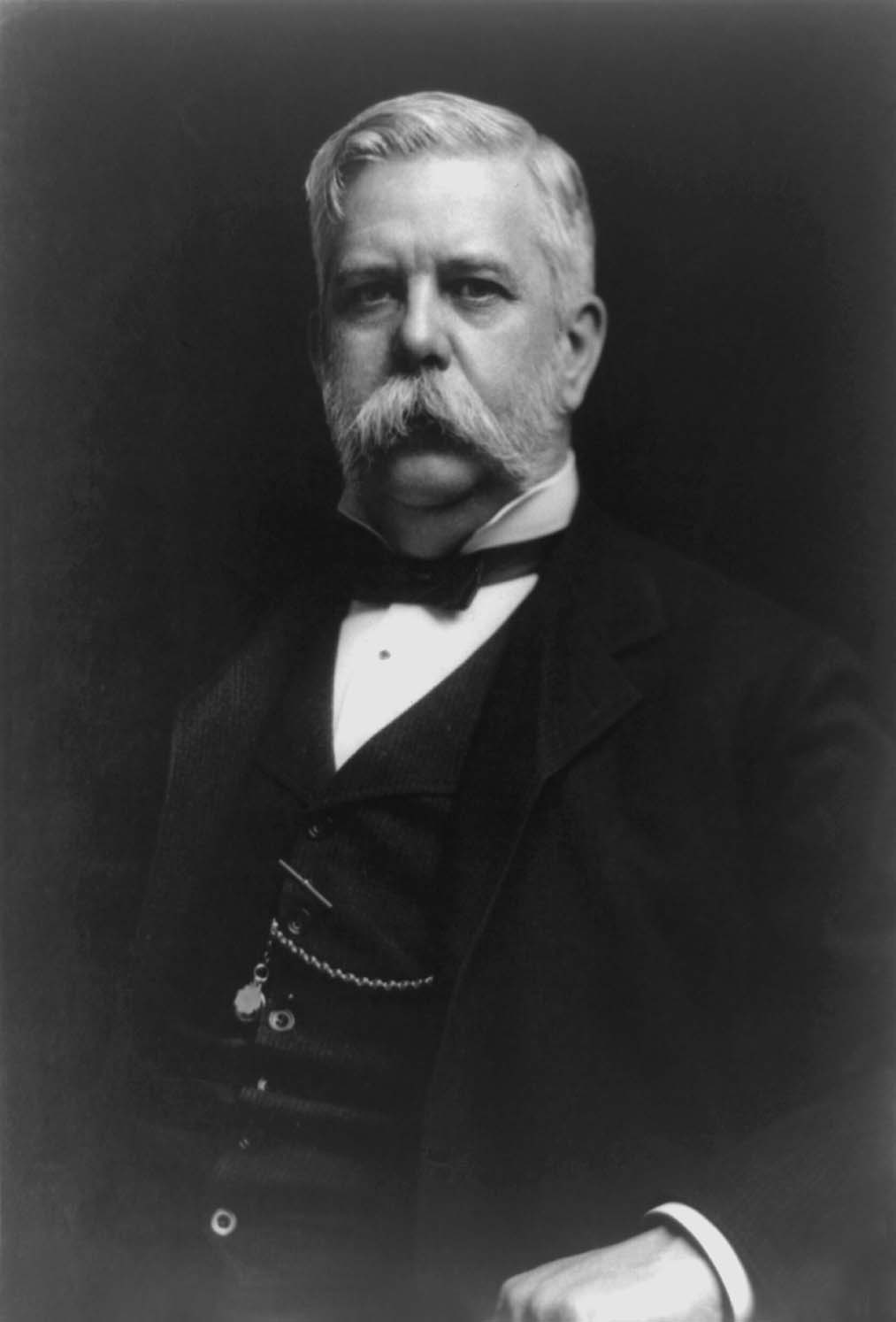
Stanley redesigned the transformer for the job. Late in 1885 Westinghouse moved him to the quiet Berkshire town of Great Barrington, Massachusetts, where in the early months of 1886 Stanley assembled a complete, practical alternating-current lighting system and demonstrated it in public. It was the first of its kind in the United States, and its architecture is the architecture of the grid in miniature. A generator produced alternating current at a moderate voltage. Stanley’s transformers stepped that voltage up — to a few thousand volts — for transmission along wires strung between the buildings and, in places, through the tops of the trees. At each shop and office to be lit, another of Stanley’s transformers stepped the voltage back down to a safe level for the incandescent lamps in the basement below. In March 1886 the main street of Great Barrington glowed with electric light delivered this way, businesses and street both, from transformers that stepped up for the run and stepped down for the load.
The Great Barrington demonstration is the moment the transformer becomes visibly, undeniably the enabling device of electric power. Every element of the modern system is present: generation at a convenient voltage, transformation up for efficient transmission, transmission at high voltage, transformation down for safe consumption. The reason to bother with all that transforming is worth stating plainly, because it is the entire economic argument for alternating current. The power lost as heat in a transmission wire is the current squared times the wire’s resistance. For a given amount of power delivered, if you raise the voltage tenfold you cut the current tenfold, and the loss — going as the square of the current — falls a hundredfold. High voltage means low current means small losses means you can send power a long way down thin, affordable wire. But high voltage is lethal to touch and useless at the lamp, so you must be able to bring it down again at the point of use, cheaply and reliably. The transformer does both, in a static box with no moving parts, at an efficiency that even in Stanley’s day exceeded ninety percent and today exceeds ninety-nine. Nothing else can. That single capability is why the transformer, and the alternating current it feeds on, won the argument that was about to erupt.
Westinghouse, convinced, put Stanley’s transformers into commercial production within a year and began building alternating-current lighting systems across the country. And with that, the stage was set for the most famous industrial quarrel of the age.
3.7 The War of the Currents
On the other side of the argument stood Thomas Edison, whose enormous prestige and formidable publicity machine were committed to direct current. Edison had built the first commercial central power station — Pearl Street in Manhattan, 1882 — and it ran on direct current at a low voltage, feeding lamps in a district close around the station. Edison knew and understood direct current intimately, held many patents in it, and had staked his business on it. He was also, on one narrow point, entirely correct: low-voltage direct current is safer to have in the house than high-voltage alternating current.
But Edison’s direct-current system had a crippling limitation, and it was precisely the limitation the transformer overcomes. Direct current, in that era, could not have its voltage changed efficiently — there was no direct-current equivalent of the transformer, no simple static box to step a voltage up and down. So Edison was stuck generating and distributing at the low voltage the lamps needed, which meant enormous currents, which meant fat, expensive copper conductors and heavy losses over any distance. In practice a direct-current station could serve only the district within a mile or so of it. To electrify a city you would have to pepper it with generating stations, each an island. To electrify the countryside, or to bring the power of a distant waterfall to a city, was simply out of the question. Alternating current, through the transformer, could do all of these things, because it could be pushed up to transmission voltage, sent far, and brought back down at the far end.
Unable to win on the engineering, Edison’s camp fought on fear. Through the late 1880s and into the 1890s the War of the Currents was waged less in the laboratory than in the newspapers and the statehouse. Edison’s associates staged grim public demonstrations electrocuting animals with alternating current to paint it as a uniquely deadly “executioner’s current.” They lobbied to have the first electric chair powered, pointedly, by a Westinghouse alternating-current generator, hoping to fix the association of alternating current with death in the public mind — Westinghouse fought the effort, and the whole grisly episode reflected far better on him than on Edison. It was a campaign of propaganda, and for a time it was ugly and effective.
It did not, in the end, matter, because the physics did not change no matter how many pamphlets were printed. Alternating current could be transformed and transmitted; direct current, then, could not. Two public spectacles settled the argument in alternating current’s favour. The first was the World’s Columbian Exposition in Chicago in 1893, which Westinghouse won the contract to light, and which he flooded with alternating-current illumination on a scale the public had never seen, demonstrating to millions that the “dangerous” current was in fact the practical one. The second was Niagara.
3.8 Tesla’s polyphase system and Niagara Falls
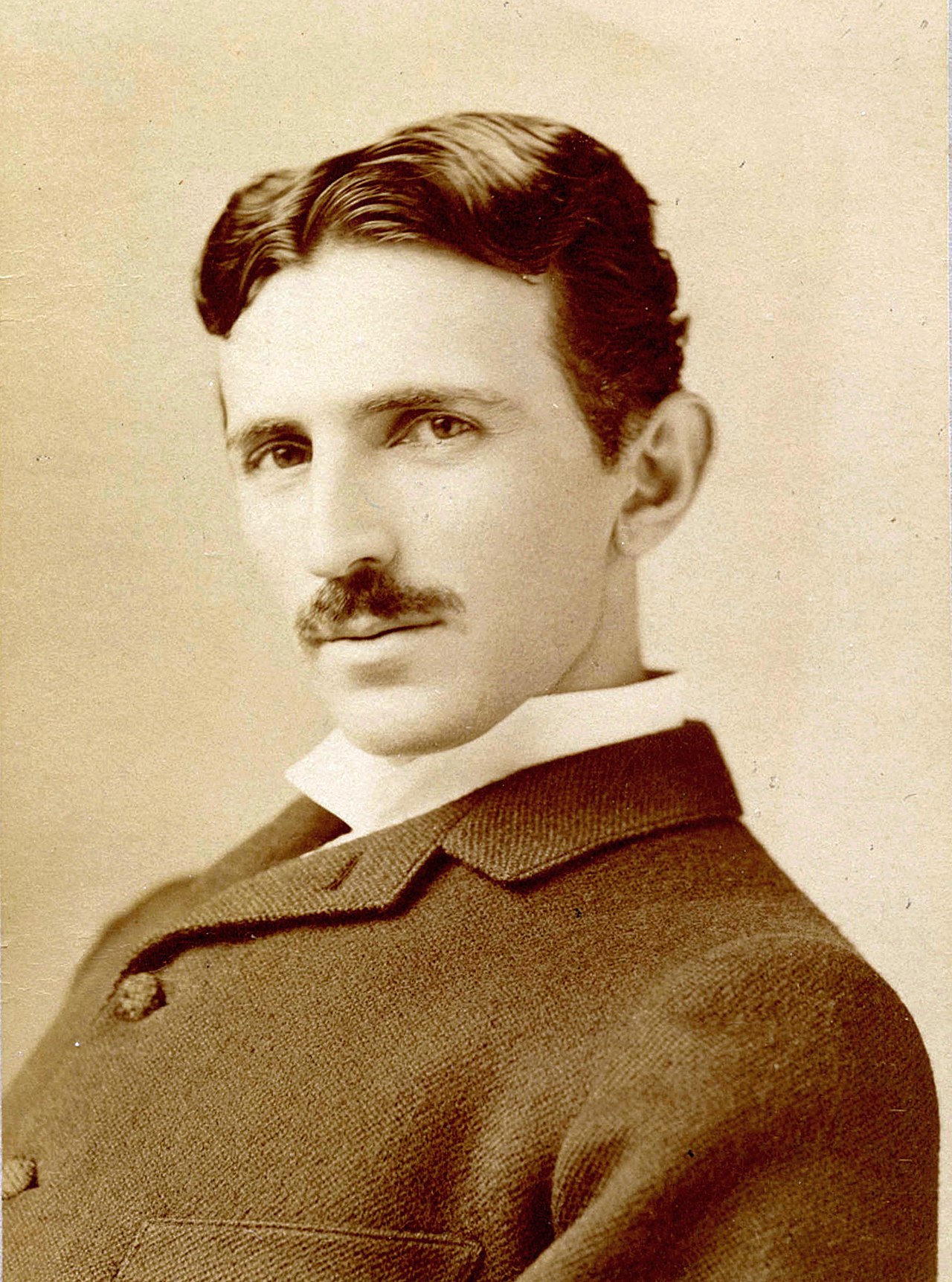
The transformer had won the transmission argument, but alternating current still had one embarrassing gap in its case, and it fell to Nikola Tesla to close it. The gap was the motor. Direct current ran motors easily and had done so for years; the early single-phase alternating current of the 1880s did not, or did so only with awkward starting arrangements. A power system that could light lamps but not turn machinery was only half a system, and Edison’s camp knew it.
Tesla, a Serbian-born engineer who had worked briefly and unhappily for Edison after emigrating to America, had been turning the problem over since his student days in Europe. His answer was polyphase alternating current: instead of a single alternating voltage, use two or three separate alternating voltages, staggered in time — offset in phase — and fed down separate pairs of wires. Send such phased currents into a set of stationary coils arranged around a circle, and their combined magnetic field does something remarkable: it rotates, sweeping smoothly around the circle like the beam of a lighthouse, with no moving parts to make it do so. Drop a simple metal rotor into that rotating field and the field drags it around. This is the polyphase induction motor, and it is beautiful — rugged, self-starting, brushless, nearly indestructible. Tesla filed the foundational patents in 1888 and presented the system that May to the American Institute of Electrical Engineers in a paper on a new system of alternating-current motors and transformers.
George Westinghouse, who missed very little, saw at once that Tesla’s polyphase system was the missing half of the alternating-current case, and in July 1888 he licensed Tesla’s patents. Now alternating current could do everything: the transformer carried the power efficiently over distance, and the polyphase motor put it to work at the far end. The three-phase form of Tesla’s idea — three voltages a third of a cycle apart — proved especially efficient for both transmission and motors, and three-phase is the form in which the world’s grids are built to this day. Every large substation transformer, including the one in the last figure of this volume, is a three-phase machine, a direct working descendant of Tesla’s insight married to the ZBD closed core.
The proof arrived at Niagara Falls. In the early 1890s an international commission wrestled with how to harness the immense power of the falls, and after long deliberation — with Westinghouse and Tesla’s polyphase alternating-current system competing against direct-current and compressed-air proposals — the commission chose alternating current. The great generators of the Adams Power Plant, built to Tesla’s polyphase design, came on line in 1895, producing power on an unprecedented scale. In 1896 that power was transmitted the roughly twenty-six miles to the city of Buffalo — a distance flatly impossible for the direct-current systems of the day — where transformers stepped it down to serve the city’s homes, streetcars and factories. Niagara was the demonstration that ended the argument. A distant waterfall was now lighting and driving a city two dozen miles away, and it was doing it because a transformer could raise the voltage for the journey and another transformer could lower it again at the end. The War of the Currents was over. Alternating current had won, and it had won on the strength of the transformer.
3.9 The modern era: the invisible machine
From Niagara onward the history of the transformer is a history of scale and refinement rather than of fresh invention, because the fundamentals were settled. The ZBD closed core, the parallel constant-voltage connection, the step-up-and-step-down architecture that Stanley demonstrated, the three-phase system that Tesla devised — these have not been superseded. They have been made bigger, quieter, cooler, and more efficient, but a modern grid transformer would be entirely recognisable to Bláthy, and its beating principle would be entirely familiar to Faraday.
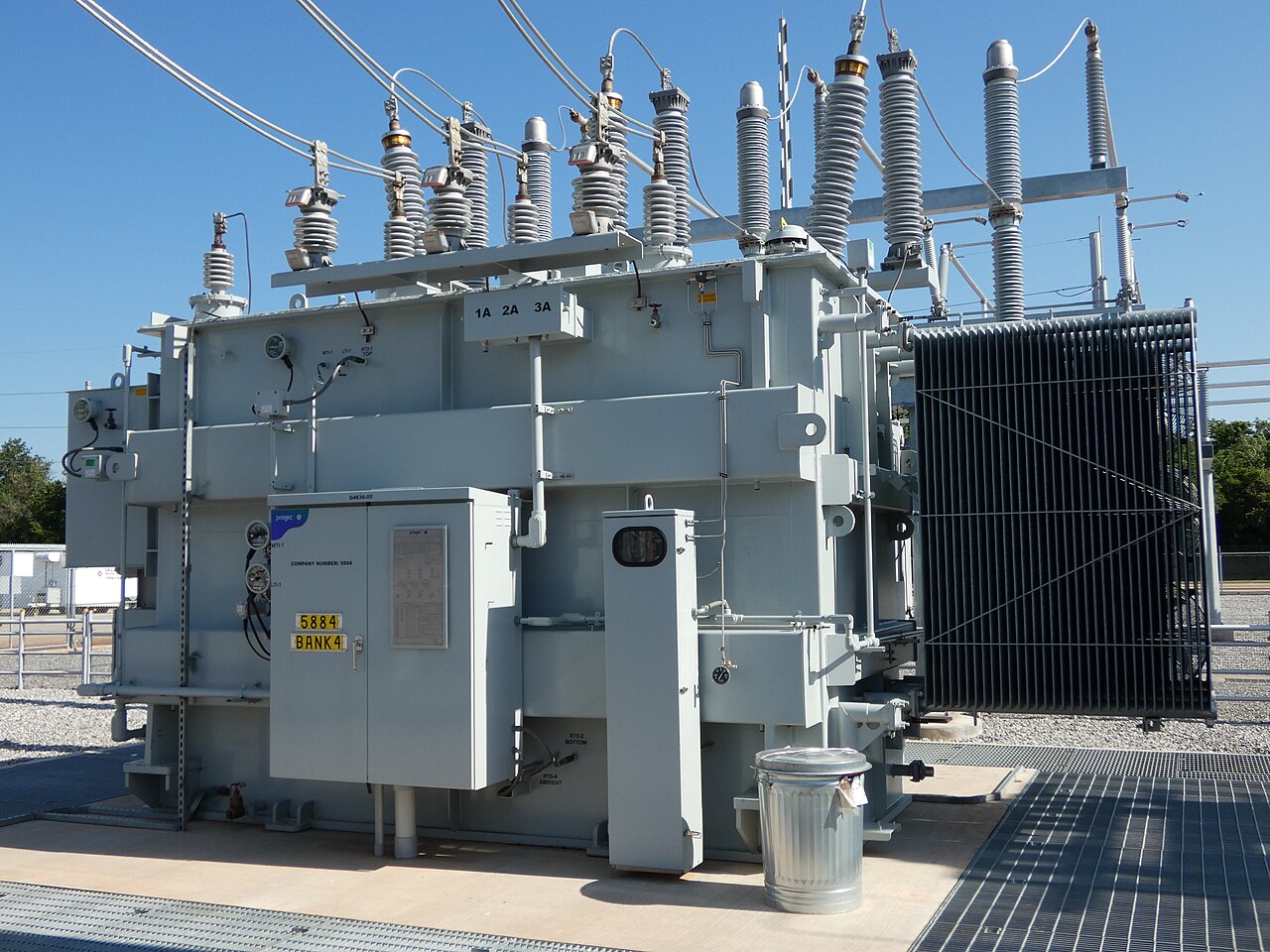
The refinements were real and hard-won, and the other volumes of this dive live among them. Better core steel was the first prize. In 1900 the metallurgist Robert Hadfield and others found that adding a few percent of silicon to iron dramatically cut the losses in a transformer core, and in the 1930s the American engineer Norman Goss developed grain-oriented silicon steel, in which the crystal grains are aligned so that the iron magnetises most easily in the direction the flux actually runs. Grain-oriented silicon steel remains the workhorse core material of power transformers today, and the core-materials volume of this dive is largely its story, alongside the newer amorphous and nanocrystalline alloys that cut losses further still. Better insulation and cooling were the second prize. Large transformers are immersed in oil, which both insulates the windings and carries their heat out to the radiators; the oil-filled tank, the bushings that bring the conductors through its lid, and the radiators bolted to its side are what give the substation transformer its characteristic industrial silhouette.
The scale is the part that would most astonish the Victorians. The transformers that Stanley wound by hand for Great Barrington handled a few kilowatts. The generator step-up transformers at a modern power station — the units that take a generator’s output of perhaps twenty thousand volts and raise it to the transmission voltage — are routinely rated at several hundred to more than a thousand megavolt-amperes, and transmission voltages of four hundred, seven hundred and sixty-five, and even over a thousand kilovolts are in service around the world. A single one of these machines can weigh hundreds of tonnes and must be moved on specially built rail cars. Yet it is, in principle, Faraday’s ring: two windings on a closed iron core, one stepping the voltage up or down for the other, working only because the current alternates and the flux therefore changes.
And at the other end of the scale the transformer has become simply universal, and therefore invisible. Every distribution transformer on every utility pole and in every green pad-mount cabinet is one of these machines, quietly stepping the medium-voltage street feeder down to the couple of hundred volts that enter a house. Every mains-powered appliance with an old-style linear supply hides a small iron transformer inside; every phone charger and computer supply hides a tiny high-frequency ferrite one, doing the same job at tens or hundreds of kilohertz — the switch-mode transformer that the types volume of this dive takes up. There are transformers in doorbells and microwave ovens, in guitar amplifiers and welding sets, in the isolation barrier that keeps a medical instrument from electrocuting a patient and in the little current transformer that lets a meter measure a heavy current safely. A modern building contains dozens of them. A person reading this sentence is almost certainly within a few metres of one and, if it is doing its job, entirely unaware of it.
3.10 The through-line: change is everything
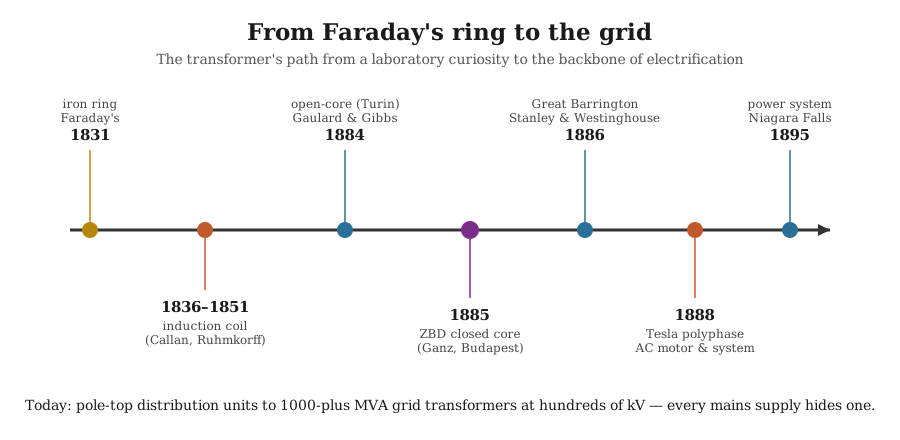
It is worth ending where the story began, because the whole history rhymes on a single idea. Faraday’s ring induced nothing from a steady current and everything from a changing one. The induction coil existed only to manufacture change, chopping a battery’s dead-steady direct current into pulses because change was the one thing a transformer could not do without. Gaulard and Gibbs failed because their open core let the changing flux leak into the air instead of driving it cleanly through the second winding. The ZBD team succeeded because they gave the flux a closed iron road, so that every bit of the change reached the secondary. Stanley and Westinghouse built an empire on the fact that alternating current changes continuously and freely, so a transformer can act on it without any chopper at all. And Edison lost, for all his genius, because direct current does not change, and a device that lives on change had nothing to grip in his system.
That is the deep reason the transformer decided the shape of the electrical world. It is a machine that trades exclusively in change — it takes a changing voltage in and hands a changing voltage out, larger or smaller in exact proportion to its turns — and it does so with no moving parts, at ferocious efficiency, from the size of a lentil to the size of a house. Because it can make voltage cheap to raise and cheap to lower, it made long-distance transmission possible; because it made transmission possible, it made the central power station and the interconnected grid possible; and because it made the grid possible, it made the electrified modern world possible. Every later volume of this dive — the equivalent circuit, the cores, the winding, the design equations, the testing on the bench — is in the end an elaboration of what Faraday saw in the flick of a galvanometer needle on a summer afternoon in 1831. The transformer is not the flashiest component in the electronics cabinet. It is merely the one without which the lights would not come on.
Comments (0)